Raised Responsibly
Here at Yum!, we believe we have a responsibility to be a good steward of the animals raised for food throughout our supply chain, as is outlined in our Global Animal Welfare Policy. Our commitment to animal health and well-being is steadfast and guided by our holistic, science-based Sustainable Animal Protein Principles.
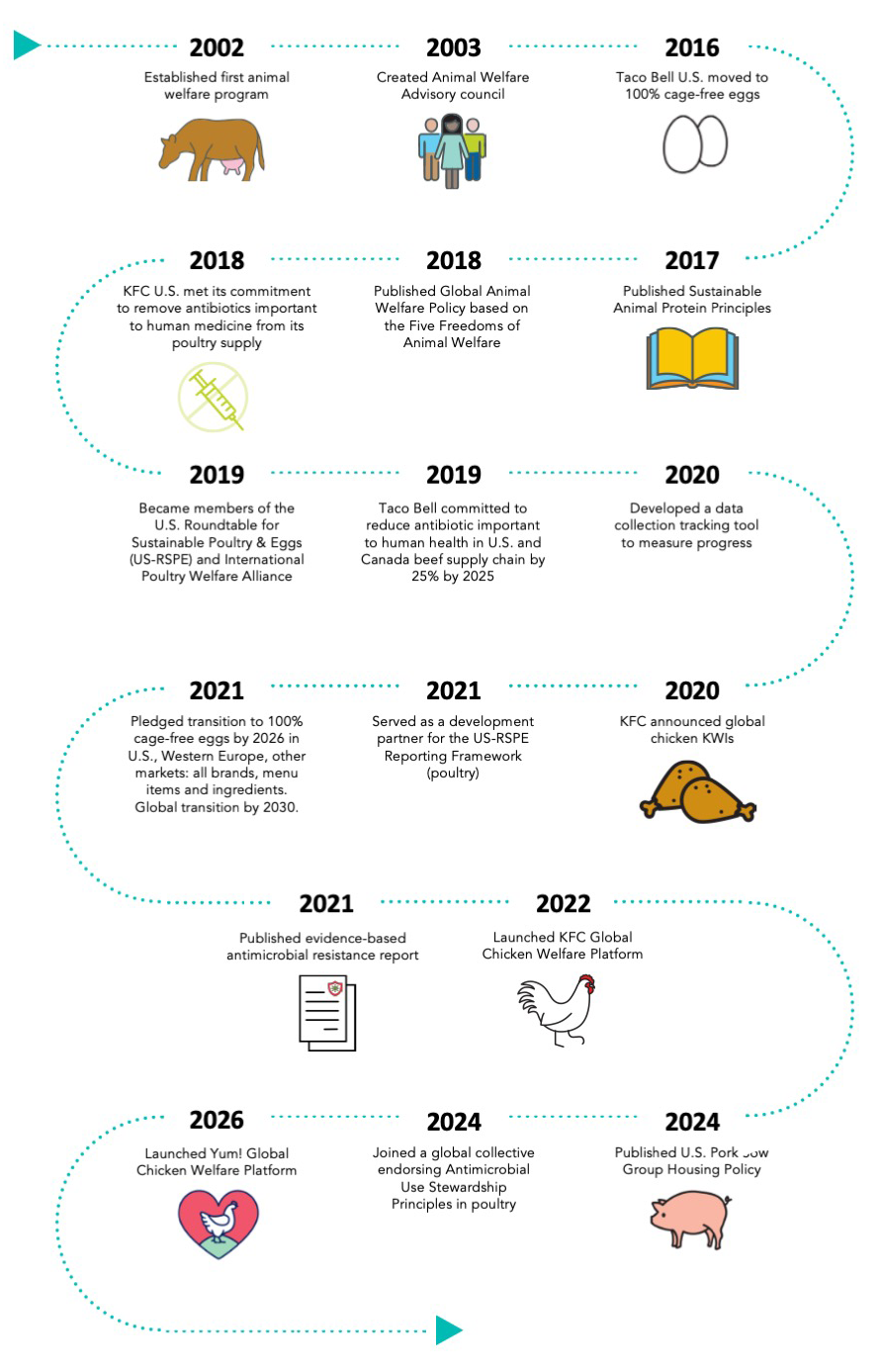
Our animal welfare journey began in 2002 with the creation of our first animal welfare program. Since then, we’ve continued to elevate our animal welfare practices across our global footprint, enabling markets to have flexibility to evolve based on customer preferences, cultural needs and expectations and local regulations. Some key milestones on our animal welfare journey include:
Chicken Welfare
Yum! Raised Responsibly is a global framework that establishes consistent expectations for chicken welfare management, measurement and data governance across our brands. Our system is a unified, science-based chicken welfare framework that is being integrated into our global supply chain and is grounded in measurable outcomes that builds on our longstanding commitment to animal welfare. We take a holistic approach to our programming that balances animal welfare, environmental impact, food safety affordability and supply chain resilience, measuring and communicating progress and collaborating with key partners. We are committed to sharing progress as we prioritize realworld welfare outcomes—health, mobility, mortality, stress indicators, and responsible medical intervention—to create clearer comparability across markets, production systems and suppliers.
Laying Hens
Making continuous improvements in our animal welfare standards and the way we source food across markets includes our work on cage-free eggs. A number of markets have already transitioned to 100% cage-free eggs including our KFC Western Europe and Taco Bell U.S. and Canada markets.
In 2021, Yum! announced a new cage-free egg commitment, pledging to transition to 100% cage-free eggs across 25,000 restaurants by 2026, including the U.S., Western Europe and other markets, across all brands for all menu items and ingredients. In the U.S., we aim to ensure at least 25% of our eggs come from cage-free hens by the start of 2023, 50% by the start of 2024, 75% by the start of 2025 and 100% by 2026.
Globally, we will work with our suppliers and key partners to increase the availability of cage-free egg sources to transition to 100% cage-free by 2030. For our 2030 global markets, we will first review sourcing data and research, before sharing progress and a potential path forward after 2026. In some regions, cage-free supply is currently limited and there is not yet a clear path for the availability of sourcing. Regardless, we are committed to working with our stakeholders to meet this end and will both disclose our progress and update our policy as we move forward so that we may remain transparent on both the challenges we face and progress we are able to make.
We will continue to collect data and work with suppliers and industry partners to make progress across the global egg supply chain and share progress updates as a part of our annual Global Citizenship & Sustainability Report.
Limiting Antibiotic Use
Our dedication to animal health and wellbeing requires thoughtful, comprehensive health management programs that may necessitate the use of antibiotics to maintain or restore good animal health. We share concerns regarding the rising threat of antimicrobial resistance (AMR) and support One Health, a holistic and multi-sectoral long-term effort to combat AMR by the United Nations World Health Organization (WHO), the Food and Agriculture Organization, the World Organisation for Animal Health and other key stakeholders.
In 2021, we published an evidence-based report that is reflective of third-party research around the global AMR scenario, and includes our AMR policies and practices. In 2024, we commissioned a third-party AMR expert to review the 2021 report and update the original research with new data and literature, and expand the scope to incorporate international information. The 2024 report is available here.
Chicken
We manage poultry antibiotic use through regionally tailored standards focused on responsible use and reduced reliance on medically important antimicrobials.
In the U.S., our brands follow Food & Drug Administration (FDA) guidelines and do not source chicken raised with antibiotics for growth promotion, with KFC and Taco Bell meeting commitments to remove antibiotics important to human medicine from their supply chains.
In Europe, Yum! supports EU Regulation (EU) 2019/6, which strengthens oversight, restricts antimicrobial use and requires justification and monitoring in food-producing animals.
Globally, Yum! participates in a broader cross-sector effort with international development and industry partners to promote responsible antimicrobial stewardship on poultry farms in line with International Poultry Council standards.
Beef
Since 2019, Yum! and Taco Bell have worked to reduce medically important antibiotics in its U.S. and Canada beef supply, advancing antimicrobial stewardship through supplier engagement, research and industry collaboration, including joining International Consortium for Antimicrobial Stewardship in Agriculture (ICASA) in 2021.
In 2025, Yum! joined the One Health Beef Project to improve feedlot-level antibiotic data and transparency and extended its ICASA membership. Additionally, the brand continued partnerships to support grazing practices, land management and cattle health.
Moving forward, Yum!’s goal is to support continuous improvements in responsible antibiotic use in the beef industry through a data-informed approach focused on measurable progress across our supply chain. This work prioritizes supplier engagement, collaboration and research to improve transparency, better link antibiotic use with animal health outcomes and support more resilient beef production systems.
Breeding Pigs
Yum! supports the ethical and responsible sourcing of pork in our restaurants which includes pregnant sows. The Yum! U.S. Pork Sow Group Housing Policy outlines our position and is grounded in our Sustainable Animal Protein Principles. We support innovations in science and research, improvements in sow welfare and the transition of the U.S. pork industry to maximize the time that pregnant sows spend in group housing.